





IATF 16949 ahead of the 2nd edition: what is now confirmed
The 2nd edition of IATF 16949 is officially in progress, with publication planned for mid-2027. In addition, ISO 9001:2026 – the base text on which IATF 16949 builds – has been available since September 2026. What is reliably confirmed, what is still open and which preparation already pays off today.

Summary
The IATF has published five revision fields and a timeline, with explicitly indicative dates. There is not yet a final text, clause allocation or transition rule for the 2nd edition. With ISO 9001:2026 published, however, the ISO base is no longer a parallel project but a concrete framework for the further IATF revision.
1. Current status
The International Automotive Task Force (IATF) announced the revision in 2024 (Stakeholder Communiqué SC-2024-006). With Communiqué SC-2026-005 of July 2026, it published five priorities and a timeline. No newer communications on the 2nd edition were available at our editorial deadline on 31 October 2026.
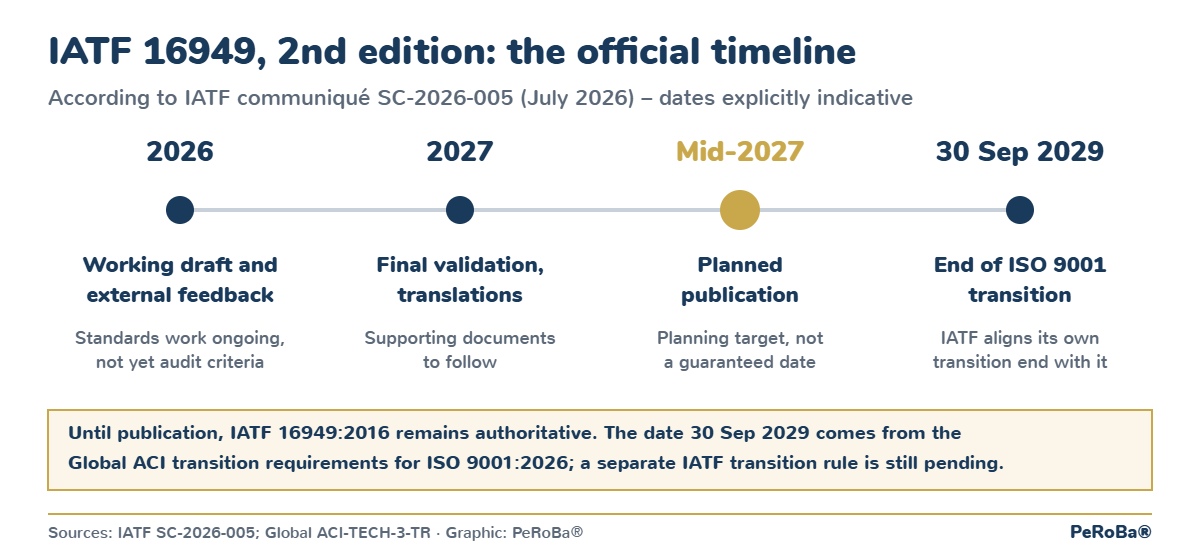
The IATF explicitly states that the dates remain indicative and may be adjusted as the work progresses. On the transition, it says the end of the transition period will be aligned with the end of the ISO 9001 transition. According to the transition requirements of the Global Accreditation Cooperation (Global ACI), that end is 30 September 2029.
Important distinction
Until the 2nd edition is published, IATF 16949:2016 remains the authoritative normative basis. Sanctioned Interpretations (SIs) clarify or change existing requirements; the Rules 6th Edition govern the certification scheme. Currently, standard SIs No. 27 to 30 (November 2025) and Rules SIs No. 22 to 27 (effective since July 2026) apply. These three levels – standard, SIs and Rules – should not be mixed up.
2. The five officially confirmed revision fields
- Simplification, clarity and efficiency: the standard is to become easier to understand, implement and audit – with less duplication of ISO 9001.
- Software quality assurance: stronger quality assurance of embedded software across its entire lifecycle.
- Tier-N supply chain management: risk-based management of lower supply tiers.
- Launch management: more emphasis on structured new product launches, change management and industrialisation.
- Customer-specific requirements (CSR): better identification and management of applicable CSRs; common CSRs could, where possible, be incorporated into the standard.
Assessment: the topics are officially confirmed. Not confirmed are specific new mandatory requirements, clause numbers, audit days or a mandatory gate model.
3. What ISO 9001:2026 has changed
ISO 9001:2026 was published on 16 September 2026. This is essential for the IATF revision because IATF 16949 builds on the ISO 9001 base text. Key points of the new edition include:
- clearer wording and improved applicability,
- a stronger focus on leadership, quality culture, ethical behaviour and accountability,
- a clearer separation of risks and opportunities,
- a new informative Annex A explaining terms and requirements,
- adoption of the current Harmonized Structure for management system standards.
More on this in our article “ISO 9001:2026 has been published – what applies now and what remains open”.
ISO 9001 transition framework
According to the Global ACI transition requirements (Global ACI-TECH-3-TR), initial and new certifications will be carried out only to ISO 9001:2026 from 31 March 2028; existing certificates to ISO 9001:2015 must be transitioned by 30 September 2029. IATF-certified organisations still need to await a separate, official IATF transition rule.
4. What companies should do now
Measures that already add value under today’s rules and remain valid regardless of the final wording make sense. We recommend five “no-regret” work packages:
- Software governance: capture product software, firmware, production and test software as well as purchased software on a risk basis; link roles, configuration, releases, changes, tests and supplier management.
- Tier-N risk transparency: do not map the entire supply chain across the board, but prioritise critical raw materials, semiconductors, special processes, single sources, geographic concentrations and change notification channels per product.
- Launch governance: bring APQP, production part approval (PPA/PPAP), capacity verification, safe launch, maturity gates, open issues, escalation and handover to series production together in one consistent steering model.
- CSR end to end: manage the source, version, scope, process reference, responsibility, training, audit coverage and effectiveness of every relevant CSR in a traceable way.
- Revision and source management: version the IATF standard, standard SIs, Rules, Rules SIs, FAQs, OEM CSRs and the ISO 9001 transition separately – with effective date, owner and implementation status.
5. A 90-day plan for robust preparation
- Weeks 1–2: define the revision owner, core team, source hierarchy and approval rules.
- Weeks 2–4: establish the baseline for the five revision fields and ISO 9001:2026.
- Weeks 3–6: carry out pilot audits on software, CSR and launch using real products or projects.
- Weeks 4–8: assess critical tier-N dependencies and information gaps on a risk basis.
- Weeks 6–10: close gaps against existing requirements immediately; document pure revision assumptions separately.
- Weeks 10–12: management review with resource decisions, residual risks and the next review date.
6. What should explicitly not be done yet
- do not relabel internal documents to presumed new clause numbers,
- do not use announced topics as new audit criteria or as a basis for nonconformities,
- do not declare Automotive SPICE a general IATF obligation unless an applicable customer or contractual criterion exists,
- do not fix any IATF transition deadlines before the IATF publishes them,
- do not mix changes to the Rules and to the standard in one undifferentiated action plan.
7. Conclusion
The direction of the 2nd edition is clearer than a few months ago: the IATF is specifically addressing comprehensibility, software quality, deeper supply chains, launches and CSRs. The most important professional boundary remains, however: announced revision fields are not yet certifiable requirements. Companies should improve their steering capability and quality of evidence today, but make formal transitions only on the basis of the published IATF text and the official transition rule.
PeRoBa® guideline
Stabilise what is already right and effective today. Make transparent what may be examined more closely in future. Wait where only the final text creates binding force.
As a member of the AIAG, PeRoBa® continuously follows the development of automotive standards. We show how to plan the transitions to ISO 9001:2026, ISO 14001:2026 and the 2nd edition of IATF 16949 together in our free webinar “Transition roadmap 2027” on 21 December 2026 (in German). You can find our services around the standard on the page IATF 16949 consulting. Book your free, no-obligation initial consultation.
Editorial sources: IATF Stakeholder Communiqué SC-2026-005 (July 2026); IATF Stakeholder Communiqués (overview); IATF 16949:2016 Sanctioned Interpretations; Rules 6th Edition Sanctioned Interpretations; ISO 9001, official standard page; Global ACI: transition requirements ISO 9001:2026 (Global ACI-TECH-3-TR). Status: 31 October 2026. This article replaces neither the purchase of the standards nor binding information from the IATF, a certification body or an oversight office. Graphics: PeRoBa®; illustration: AI-generated with Microsoft Copilot.