



IED 2.0: The environmental management system becomes a compliance factor
Since 19 October 2026, the German act transposing the revised Industrial Emissions Directive has been promulgated. For operators of industrial installations, the environmental management system thus turns from a voluntary choice into an operator obligation – and the internal audit becomes the first test.

In brief
IED 2.0 widens the focus from emissions to measurable environmental performance. For installations in scope, environmental management, resource indicators, BAT requirements and reliable evidence become much more closely linked.
Legal status: what is settled and what is still open
Directive (EU) 2024/1785 amending the Industrial Emissions Directive 2010/75/EU entered into force on 4 August 2024; Member States had to transpose it into national law by 1 July 2026. In Germany, the Bundestag adopted the transposition act on 9 July 2026 and the Bundesrat let it pass on 25 September 2026. On 19 October 2026, the “Act transposing Directive (EU) 2024/1785 amending Directive 2010/75/EU on industrial emissions” was promulgated (Federal Law Gazette BGBl. 2026 I No. 304). It amends in particular the Federal Immission Control Act (BImSchG).
The details of the environmental management system are set out in a separate ordinance, the new 45th BImSchV. The Bundesrat approved it on 25 September 2026 only subject to amendments. At our editorial deadline on 31 October 2026, we were not aware of its promulgation. Detailed requirements and deadlines should therefore be checked against the published final version before implementation.
Important note
This article summarises the legal and procedural status as of 31 October 2026. It does not replace a legal assessment of the individual case or a review of the specific permit.
From emission limit values to measurable environmental performance
IED 2.0 no longer focuses solely on classic emission limit values. Environmental performance levels gain weight, in particular the consumption of water, energy and material resources. The conclusions on best available techniques (BAT) remain decisive. Operators must therefore not only comply with limit values but also collect and assess suitable data and be able to demonstrate them transparently to the authorities.
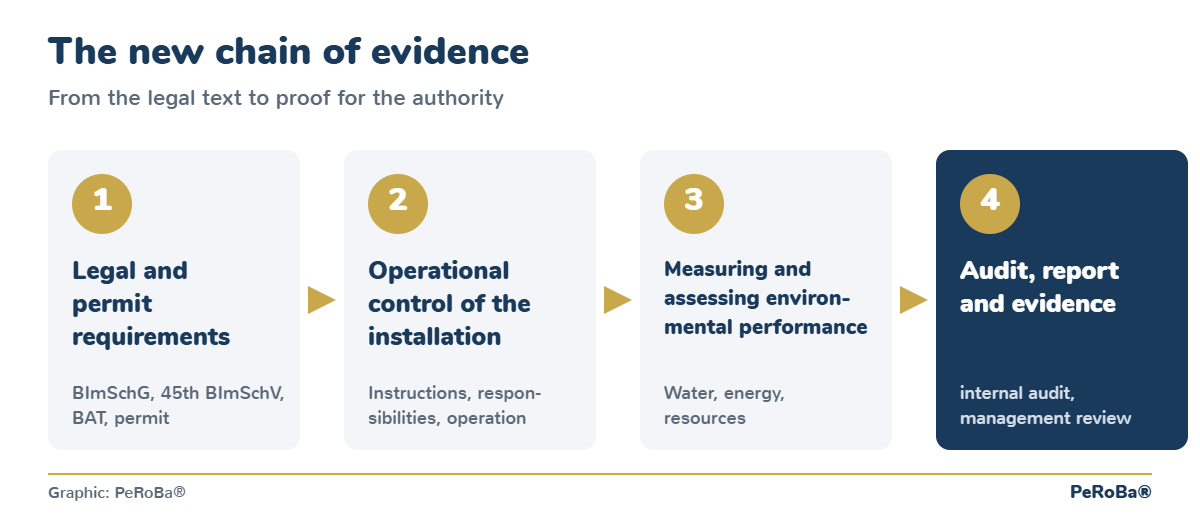
In practice, this creates a continuous chain of evidence: legal obligation, operational control, measurement and assessment, and a documented improvement process.
Environmental management system: from voluntary choice to operator obligation
A central element of IED 2.0 is the obligation for operators in scope to establish and apply an environmental management system. According to the known regulatory status, a first proof is envisaged for existing installations by 1 July 2030; for installations commissioned later, at the latest by commissioning. Which date applies in an individual case depends on the type of installation, transitional provisions and the final wording of the ordinance.
A certificate to ISO 14001 or an EMAS registration can provide a sound basis for demonstrating conformity. What matters, however, is whether the specific system actually covers the installation-related legal obligations, BAT requirements, measurement concepts and evidence.
The Bundesrat relies on the internal audit
Of particular practical importance are the amendments under which the Bundesrat approved the 45th BImSchV:
- Conformity of the environmental management system is to be checked for the first time within an internal audit; a confirmation of the successful audit counts as proof.
- Besides ISO 14001 and EMAS, sector-specific and integrated management systems are also to be recognised as proof.
- The obligation to publish information on the environmental management system on the internet is to be dropped.
Whether these amendments become part of the final version unchanged will be decided with its promulgation. The direction, however, is clear: if the first proof is provided through an internal audit, the reliability of that proof depends directly on the quality of the audit. An internal audit that merely ticks off documents will not do. What is needed are installation-specific audit criteria, sound objective evidence and auditors who understand legal requirements, BAT conclusions and measurement concepts.
ISO 14001 is a good basis, but not automatic IED proof
An effectively operated environmental management system to ISO 14001 already contains key elements: environmental aspects, compliance obligations, operational control, emergency preparedness, monitoring and measurement, evaluation of compliance, internal audits and management review.
Certification alone, however, does not answer whether all IED-specific operator obligations are met. Additional review is often needed on the following topics:
- delimitation of the installation concerned and assignment to the list of installations in the 4th BImSchV
- translation of permit conditions and BAT conclusions into operational requirements
- measurement and data concepts for water, energy, raw materials and other resources
- definition of reliable environmental performance indicators and targets
- reporting, submission and evidence obligations towards the authority
- audit scope, installation reference and reliable proof of conformity
What companies should do now
- Check applicability reliably: compare installations, ancillary units, activities and capacity thresholds with the current list of the 4th BImSchV and the permits – per installation, not just at company level.
- Carry out an IED gap analysis: mirror the existing ISO 14001 or EMAS system against the new operator obligations – checking not only documents but also data quality, responsibilities and operational implementation.
- Stabilise the measurement and data concept: define measured variables, data sources, plausibility checks, responsibilities, retention and reporting lines; clean up missing consumption data or inconsistent reference values early.
- Integrate BAT and permit management: systematically transfer BAT conclusions, permit conditions and regulatory requirements into the legal register, operating instructions, monitoring plans and compliance evaluations.
- Make internal audits fit to serve as evidence: plan internal audits per installation, define objective evidence and design them so that they hold up as first proof towards the authority; extend the management review to environmental performance, legal compliance and investment needs.
- Keep monitoring legal developments: follow the final version of the 45th BImSchV and the Environmental Omnibus package proposed by the European Commission on 10 December 2025, which provides for more flexibility regarding the environmental management system under the IED.
Considering IED 2.0 and ISO 14001:2026 together
For many companies, regulatory and normative changes coincide: a new edition of ISO 14001 has been available since April 2026. It therefore makes sense not to build the IED requirements as a separate parallel project. An integrated approach is more efficient: use existing environmental management processes, add IED-specific requirements and consistently align evidence with installation and data level. We show how to plan the transitions to ISO 14001:2026 and ISO 9001:2026 together in our free webinar “Transition roadmap 2027” on 21 December 2026 (in German).
Conclusion
IED 2.0 turns environmental management into a question of demonstrable compliance. For operators concerned, it will no longer be enough to organise environmental issues in general terms. Legal obligations, BAT requirements, environmental objectives, measured values and operational evidence must be combined into a robust overall system.
Companies with an effective environmental management system to ISO 14001 or EMAS have a good starting point. The task now is to establish the specific installation reference, identify gaps in good time and set up internal audits so that they stand up as proof.
How well is your environmental management system prepared for IED 2.0?
PeRoBa® supports you with applicability checks, IED gap analyses, the further development of your environmental management system to ISO 14001 and with internal audits fit to serve as evidence – following our principle of “helping you help yourself”. Book your free, no-obligation initial consultation.
Editorial sources: Directive (EU) 2024/1785; BGBl. 2026 I No. 304; German Bundestag, resolution of 9 July 2026; Bundesrat, printed paper 36/26 (resolution) of 25 September 2026, amendments No. 29 and 30. Legal status: 31 October 2026. Graphics: PeRoBa®; illustration: AI-generated with Microsoft Copilot.