




Automotive Core Tools Online Quiz: evidence for VDA 6.3 and IATF auditors
To ensure that the automotive quality methods and tools – the Automotive Core Tools – are assessed competently in audits, VDA QMC requires evidence of this knowledge in its qualification requirements for process and system auditors. The Automotive Core Tools Online Quiz (VDA QMC, ID 400) is one way of providing this evidence.
According to VDA QMC, the quiz is aimed at candidates for the VDA 6.3:2023 process auditor (ID 382) and IATF 16949 1st/2nd party auditor (ID 250) examinations who have not attended a core tools training course at VDA QMC or a licence partner (ID 415:2022 or ID 417:2019). A prerequisite is a core tools training course of at least two days (from 2019 onwards) with another provider. According to training providers, the quiz can also be used for the requalification of VDA 6.3 auditors.
The quiz is considered demanding: the questions are technically in-depth, often statistical, and require detailed knowledge. Even experienced auditors report that they only just achieved the required 21 correct answers out of 30. There is only one attempt, it cannot be repeated, and the time allowed is 60 minutes. Anyone who fails does not receive a certificate and must demonstrate their core tools knowledge in another way, for example through a core tools training course at VDA QMC or a licence partner.
Procedure and structure of the VDA Automotive Core Tools Online Quiz
The procedure of the VDA online quiz is very straightforward. Registration is via the VDA webshop; the fee is EUR 50 plus VAT. First you register for the quiz and confirm the information on the procedure and the terms of use. The quiz language is English. Of the 30 questions, at least 70% must be answered correctly – that is 21 questions.
The questions are single choice, each with four possible answers. As usual with this type of question, you also have the chance to answer questions correctly by a process of elimination. A total of 60 minutes is available for the 30 questions.
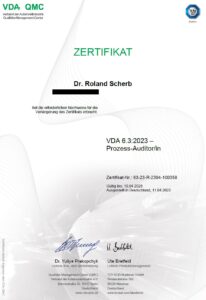
The result is available immediately after the test, and if you pass you can download a certificate as a PDF.
Focus areas and assessments of the VDA online quiz
Feedback from participants points to a very strong focus on statistics and general theory. Because of the large pool of possible questions and answers, there is a high probability of encountering problems where even long practical experience requires you to read very carefully and not read anything into them. A frequent criticism is therefore that some questions are rather far removed from practice. Others simply regard the questions as essential basic knowledge for VDA 6.3 and IATF auditors. There is no reasonably complete question catalogue – the original VDA QMC questions are not public.
Our managing director took this test to extend his VDA 6.3 qualification and found the correct answers to almost all questions. Based on his feedback, the topics covered included:
- GRR method
- Shewhart control chart
- sampling for long-term process capability
- APQP phases
- determination of measurement uncertainty
- measurement system analysis (MSA)
- FMEA
- probability plot
- VDA maturity level assurance (MLA), VDA Volume 2 and other VDA volumes
- some further topics and technical questions from everyday auditing and their assessment
How best to prepare for the VDA quiz
This quiz is not something you do on the side. The questions must be read carefully, and technical competence is required. Thorough preparation for the VDA online quiz is therefore strongly recommended – especially for the methods and procedures you have had less to do with in your own practice.
Our recommendation: method-based preparation
Work through the core tools systematically: APQP and PPAP or PPA (VDA Volume 2), FMEA according to the AIAG & VDA FMEA handbook (2019), measurement system analysis and measurement uncertainty, statistical process control (SPC) and process capability. What matters is understanding the indicators and how to assess them, not memorising.
A good self-check is the free AIAG Core Tools Self-Assessment. In our experience, however, it does not cover all topics of the VDA quiz.
Practice questions for self-assessment
PeRoBa®’s own practice questions for checking your knowledge – not original VDA QMC questions.
What does the %GRR value of a measurement system analysis indicate?
A) The process capability of production · B) The share of repeatability and reproducibility of the measurement system in the tolerance or total variation · C) The calibration uncertainty of the standard · D) The number of distinct appraisersAnswer: B. According to the AIAG MSA reference manual, values below 10% are generally considered acceptable, 10–30% conditionally acceptable and above 30% unacceptable.
Where are the control limits of a Shewhart control chart (x̄/R chart) usually located?
A) At the tolerance limits · B) At ±2 standard deviations of the individual values · C) At ±3 standard deviations of the sample statistics around the centre line · D) As specified by the customerAnswer: C. Control limits are calculated from the process, not from the tolerance.
What is the difference between Cpk and Cp?
A) Cpk also takes into account the position of the process relative to the centre of the tolerance · B) Cpk only applies to attribute characteristics · C) Cpk is calculated only from short-term data · D) There is no differenceAnswer: A. Cp only describes the ratio of tolerance to process spread; Cpk additionally assesses the distance of the mean from the nearer tolerance limit.
Which phase is not one of the five APQP phases?
A) Product design and development · B) Process design and development · C) Product and process validation · D) Supplier audit according to VDA 6.3Answer: D. The five APQP phases are: planning, product design and development, process design and development, product and process validation, and feedback, assessment and corrective action.
How does the AIAG & VDA FMEA handbook (2019) prioritise actions?
A) Risk priority number (RPN) · B) Action priority (AP) · C) Pareto analysis · D) Fault tree analysisAnswer: B. In the harmonised handbook, action priority replaces the RPN as the basis for assessment.
Support with your preparation
Would you like to know which route to evidence suits your qualification, or refresh your core tools knowledge in a targeted way? We support you individually – following the principle of help for self-help. In a free, no-obligation initial consultation we answer your questions. More on the methods on our page on the IATF 16949 core tools.
Automotive Core Tools Online Quiz – frequently asked questions
What is the VDA Automotive Core Tools Online Quiz?
An online test by VDA QMC (ID 400) with which auditors can demonstrate their knowledge of the Automotive Core Tools – for example for the VDA 6.3:2023 process auditor examination or the IATF 16949 1st/2nd party auditor examination.
Who has to take the online quiz?
According to VDA QMC, it is intended for examination candidates who have not attended a core tools training course at VDA QMC or a licence partner (ID 415:2022 or ID 417:2019). A prerequisite is a core tools training course of at least two days (from 2019 onwards) with another provider.
What does the online quiz cover?
The question pool is extensive. Topics include the GRR method, Shewhart control charts, long-term process capability, APQP phases, measurement uncertainty, measurement system analysis (MSA), FMEA, probability plots, VDA maturity level assurance and VDA Volume 2.
How does the quiz work?
After registering via the VDA webshop (EUR 50 plus VAT), 30 single-choice questions with four answers each are asked in English. At least 70% (21 questions) must be answered correctly within 60 minutes. There is only one attempt. The result is available immediately and, if passed, a certificate is provided as a PDF.
What is the best way to prepare?
We recommend a method-based approach: work through the core tools systematically, understand the indicators and how to assess them, and check your knowledge with practice questions. We are happy to support you individually.
Further reading
Would you like to put your knowledge into practice? Read more about IATF 16949 consulting, the IATF 16949 certification process, VDA 6.3 process audits and auditor training and quality management in the automotive industry. In a free, no-obligation initial consultation we will be happy to answer your questions.
About PeRoBa®:
PeRoBa® Unternehmensberatung GmbH has specialised in management systems since 1991. The company has been headquartered in Baldham since 2011 and also maintains an office on Prinzregentenstraße in Munich. PeRoBa® advises, audits and assesses to support clients in introducing and implementing their management systems, and also offers audits, QM training, seminars and workshops. Since January 2016, the in-house, patented software iVision® – Smart Remote Audit Solution has been on the market.
Dr. Roland Scherb is the founder and Managing Director of PeRoBa® Unternehmensberatung GmbH, certified to DIN EN ISO 9001, ISO 14001 and ISO 27001 and based in Baldham. He is President of the Bundesverband der Auditoren e. V. (German Federal Association of Auditors), head of the ISO Certification Competence Forum at BVMW e. V. (German Association for Small and Medium-sized Businesses) and a member of the DIN working committee NQSZ NA 147-00-07 GA on the revision of DIN EN ISO 19011. He is also a book author as well as a trainer and lecturer at renowned educational institutions on management systems and the associated core methods.

How may we help you?
Arrange a free, no-obligation initial consultation via online appointment, or send us a message using our contact form. You are also welcome to call us.
In the free initial consultation, we first clarify your needs.