



What is FMEA?
The FMEA method (Failure Mode and Effects Analysis) is used to optimize products and processes with a view to failure prevention and technical reliability. It is particularly effective as early as the design and development phase of new products or processes: potential failures are identified, their significance for customers is assessed, and their likelihood of occurrence is minimized.
The aim of FMEA is to prevent failures from the outset. This saves the effort and cost that would otherwise arise only when failures are detected and have to be corrected. Across product life cycles and product variants, FMEA also effectively prevents design weaknesses from being repeated.
Goals of FMEA consulting
FMEA consulting serves to implement this proven method effectively and in a way that fits your company. Typical core goals of FMEA consulting include:
- Identifying process failures in your company at an early stage and taking suitable countermeasures
- Reducing customer complaints, claims and returns
- Preventing known product failures and defects in future products
- Methods for sharing quality management knowledge, for example across departments
- Raising awareness of quality management throughout the company
As part of our FMEA consulting we introduce your employees to the subject step by step and help you select suitable tools. PeRoBa® Unternehmensberatung GmbH also supports you in further developing existing quality management processes based on the FMEA method.
Our work is based on the current AIAG & VDA FMEA Handbook.
The steps of an FMEA
In practice, the FMEA method is applied in seven consecutive steps:
Planning and preparation (scoping)
Scoping defines what the analysis covers and what it does not: the project, its boundaries, the team, the schedule and the tools.
Structure analysis
All system elements involved are recorded precisely in order to create a detailed system structure. This structure is the basis for checking and verifying the properties defined for the system.
Function analysis
Functions are assigned to the identified system elements and linked to form a function network. This allows the system requirements to be verified effectively.
Failure analysis
Failure modes are assigned to the functions and linked to form a failure network. This makes it possible to identify potential failures and their causes at an early stage.
Risk analysis
In the FMEA form, the current state is linked to prevention and detection controls. Severity, occurrence and detection are rated, and the Action Priority (AP) shows where action is needed first.
Optimization
Based on the risk analysis, further actions are defined to reduce or eliminate failures. It is particularly important to name specific due dates and the persons or organizational units responsible. In this way, a forward-looking quality policy that keeps improving can be planned, implemented and documented.
Results documentation
The results and the remaining risks are documented and communicated.
Why preventive failure avoidance is necessary
In practice, the same entrenched patterns appear again and again. They hinder effective failure prevention and make risk management unnecessarily difficult. Above all, awareness of the need for early risk analysis is often missing or underdeveloped. Even managers frequently do not see the purpose and benefit of such activities. As a result, risk analyses are either not supported by existing processes at all or do not follow an interdisciplinary approach. In addition, risk analysis often takes place only under external pressure from a customer or supplier, or after problems have occurred, and not on the company’s own initiative.
Here too, external consulting with suitably trained trainers can increase acceptance and initiative. The best quality management grows out of a company’s own dissatisfaction with the status quo.
Checklist: step by step to an effective FMEA
| Phase | Checkpoints | Status |
|---|---|---|
| 1. Preparation | Define the goal and scope of the FMEA | ⬜ |
| Assemble the team (interdisciplinary) | ⬜ | |
| Analyze the process or product structure | ⬜ | |
| Collect documents and data for the analysis | ⬜ | |
| Train the team in FMEA methodology | ⬜ | |
| 2. Conducting the FMEA | Identify potential failure modes | ⬜ |
| Evaluate causes and effects | ⬜ | |
| Determine the Action Priority (AP) | ⬜ | |
| Evaluate existing prevention and detection controls | ⬜ | |
| Derive recommended actions | ⬜ | |
| Complete the FMEA documentation | ⬜ | |
| 3. Follow-up | Create and communicate the action plan | ⬜ |
| Track implementation of the actions | ⬜ | |
| Verify the effectiveness of the actions | ⬜ | |
| Review and update the FMEA regularly | ⬜ |
FMEA consulting backed by experience
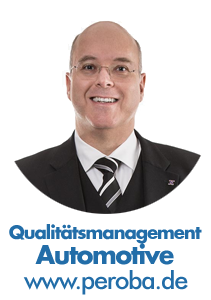
Dr. Roland Scherb has many years of national and international experience as an auditor and management consultant with a focus on ISO 9001, VDA 6.3 and IATF 16949. Sound theory and proven practice help you and your company get the best out of your quality management. PeRoBa® Unternehmensberatung GmbH is your long-term partner for consulting, implementation and training.

About PeRoBa®:
PeRoBa® Unternehmensberatung GmbH has specialized in management systems since 1991. The company’s administrative headquarters have been in Baldham since 2011, and it also maintains an office on Prinzregentenstraße in Munich. PeRoBa® advises, audits and assesses to support clients in introducing and implementing their management systems, and also offers audits, QM training, seminars and workshops. Since January 2016, the in-house software iVision® Smart Remote Audit Solution has been on the market; it is based on our patented method for visual order-picking support (DE 10 2015 117 554 B4).
Dr. Roland Scherb is the founder and Managing Director of PeRoBa® Unternehmensberatung GmbH, certified to DIN EN ISO 9001, ISO 14001 and ISO 27001, with administrative headquarters in Baldham. He is President of the Bundesverband der Auditoren e. V. (German Federal Association of Auditors), head of the ISO Certification Competence Forum at BVMW e. V. (German Association for Small and Medium-sized Businesses) and a member of the DIN working committee NQSZ NA 147-00-07 GA on the revision of DIN EN ISO 19011. He is also a book author as well as a trainer and lecturer at renowned educational institutions on management systems and the associated core methods.

How may we help you?
Arrange a free, no-obligation initial consultation via online appointment, or send us a message using our contact form. You are also welcome to call us.
In the free initial consultation, we first clarify your needs.